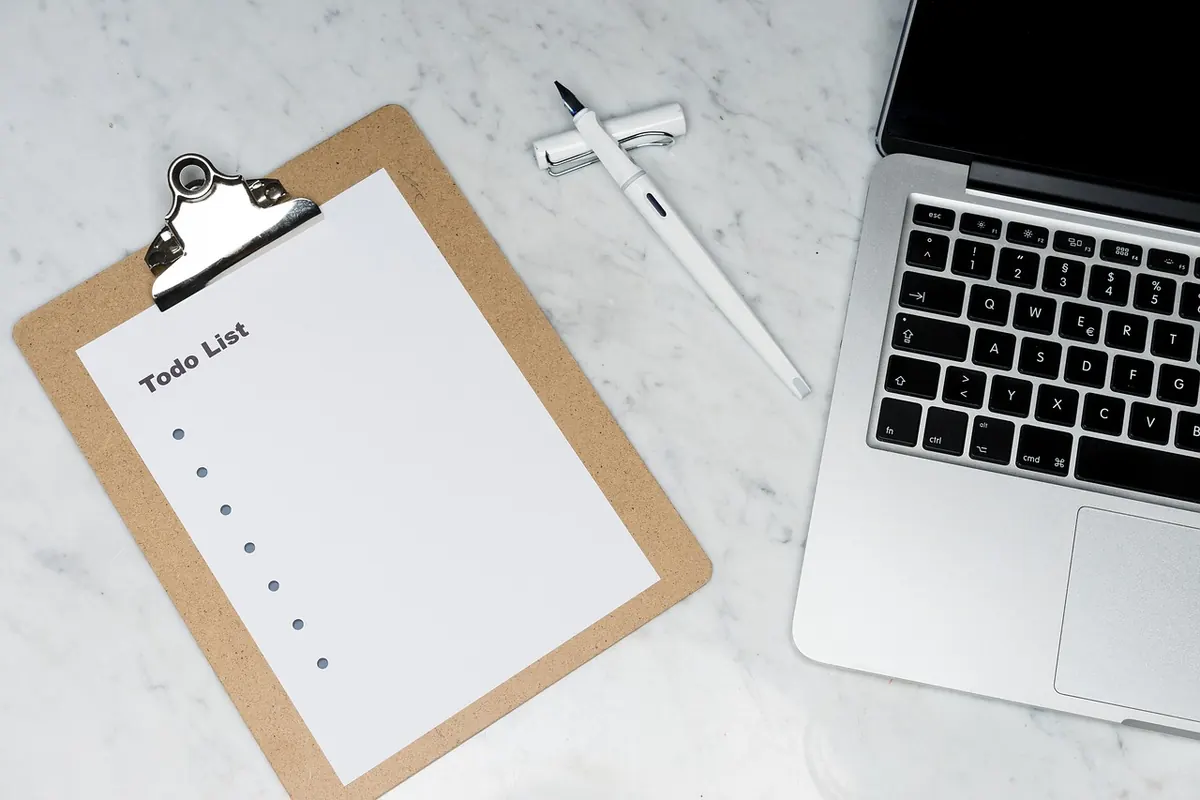
Why Your To-Do List Fails: 7 Common Planning Mistakes
A to-do list usually fails because of how it is written, not because of laziness. Here are seven common...


Two days at home, three in the office. Or three at home, two in a shared workspace. However your week splits, the practical problem is the same: the work doesn't change, but the conditions do. A task that takes forty minutes at your kitchen table can take ninety at a hot desk, and the reverse is just as true.
Time blocking — deciding in advance what you'll work on and when — is usually taught as if you have one desk and one set of distractions. Hybrid working adds a second layer: choosing not just when a task happens, but where it happens. Get that match right and the week starts to feel considerably calmer.
Most people plan a week by listing tasks and then squeezing them into whatever gaps are left. Try it the other way round. Put in the parts that can't move first: which days you're expected on site, the team meeting that's always Tuesday at ten, the school pickup, the gym session you actually attend.
Once those anchors are in the calendar, you can see the shape of the week and how much genuine planning space remains. A week with three office days and two meetings each will have far less room for focused work than a week spent at home. Pretending otherwise is how plans collapse by Wednesday lunchtime.
Not every task improves at home. Before building any blocks, run your regular work through three rough buckets:
Then take one more step and be honest about yourself. Some people do their best thinking on a train. Others work brilliantly in an office and get nothing done at a kitchen table next to a pile of washing. Your blocks should reflect your reality, not an ideal version of it.
Time blocking in hybrid work isn't about squeezing more in. It's about putting the right work in front of the right version of you.
You don't need a perfect week. You need one you can repeat with small adjustments. Try this:
Hybrid weeks contain more edges than office weeks, and that's where the time quietly disappears. The commute, the walk from the spare room to the kettle, the ten minutes of where was I? at the start of every day.
Two small blocks fix most of it. The first is a start-up block: ten minutes to check the plan and choose your first task before anything else gets a vote. The second is a shutdown block of similar length, where you write down tomorrow's first task and close the laptop properly. On office days, the commute can do part of this job; on home days, a short walk before you start does something similar for your attention.
Keep them short. A transition ritual that takes twenty-five minutes won't survive a busy Thursday.
Plans break. A meeting overruns, a colleague needs you, a delivery arrives, a child comes home early. The mistake is treating a lost block as a lost day and abandoning the rest of it.
Do this instead: halve it. If your 90-minute writing block shrank to 40 minutes, still do the 40 minutes. A shortened block keeps the rhythm going and usually produces more than a rearranged afternoon.
It also helps to keep one spillover block in the week — Thursday afternoon, for example — where unfinished work lands without spilling into Friday or the weekend. Then review. At the end of the week, ask one question: which block was pushed aside most often, and why? Sometimes the answer is the time of day. Sometimes it's that the block was never realistic to begin with.
Keep the first attempt small. Choose three blocks for the week ahead: one deep-work block on a home day, one collaborative block on an office day, and one buffer. Write them somewhere you'll actually see them — a paper diary works as well as any app, and it's harder to ignore.
If a block works, repeat it next week. If it doesn't, move it, shorten it, or cut it. Six or seven weeks of small adjustments will give you a template you trust. That's the real benefit: a week that's already decided, so your mornings stop beginning with a negotiation about what to do first.
Photo: StockSnap / Pixabay
A to-do list usually fails because of how it is written, not because of laziness. Here are seven common...
A practical one-day method for clearing downloads, desktop clutter, browser tabs and cloud folders — plus...
Five practical checks for chair, screen, keyboard, lighting and breaks that make a UK kitchen table...